
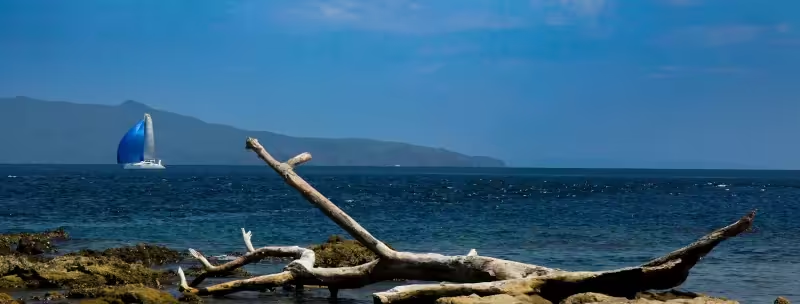


Sail Around the Islands of Romblon
Romblon province comprises 20 islands: three large and diverse (Romblon, Sibuyan and Tablas), three intriguing and connected by a common dialect (Banton, Simara and Sibale) and fourteen, smaller that share some common traits. All the islands exist within the Sibuyan Sea, which encompasses the geographic heart of the Philippines.
Three islands provide a good typhoon-shelter (Romblon, Sibale and Tablas). All were inhabited for many centuries before the Spanish arrived in 1856. None are mainstream tourist destinations, largely because inter-island travel is not quite convenient, but each one will willingly share its special gifts with the inquisitive adventurer or researcher.

Romblon Island
Romblon is the island that gives its name to the province, with Romblon town as the Provincial capital. Famed as the "Marble Capital of the Philippines", its most famous export is marble, mostly mined from northern portion of the island. The marble may be exported as block or sheet, but the island has become most famous for its highly-skilled (and mostly self-trained) marble carvers. It is oft said that if you offer a photograph of your desired marble sculpture and provide a size for the finished item then within two days it will be ready for pick-up.
Romblon harbor, almost completely surrounded by Romblon town, has forever been known to be a typhoon shelter and can become rather crowded if a storm is forecast to be passing close.
Just West of the town is the vanishing (at high-tide), white-sand sand bar, known as Bon Bon Beach, that joins to Bang-og Island; the sand bar is a popular location for "selfie" photography. Immediately South of the sandbar is a good anchorage on sand with little chance of damage to the marine ecosystems.
Beneath the passage between Bon Bon Beach and Logbon Island, to its North, is known for its diverse coral habitats and here live at least 13 globally-rare specie of nudibranch. Coral is a feature all around Romblon Island so the aforementioned on-sand anchorage South of Bon Bon Beach is a rarity, to be enjoyed.
The bay at Romblon town was considered significant by the Spanish as a protected harbor for their trading ships and two forts were built in the steep hills overlooking the bay, reportedly to provide early warning of, and to protect against, marauding pirates from Borneo and what is now Mindanao. The northern-most of the forts is itself now protected for viewing by tourists.
You can replenish most stocks of food and fuel in Romblon town and there are a handful of ATMs for cash withdrawals.
Sibuyan Island
The island of Sibuyan has been dubbed the "Galapagos of Asia", primarily because of the diversity of plant and animal life that inhabit its rugged, forested interior – almost everything natural grows here to extremes, large and small. The center of the island is dominated by the impressive, saw-tooth-ridged Mount Guiting-Guiting. There are actually too many species endemic to Sibuyan Island to list them all here (fifty-four plants, four rodents, two birds and one bat specie), plus hundreds more that are Philippine endemic and resident on Sibuyan, so if endemics are on your bucket list then this island alone can occupy you for weeks, if not months.
Sibuyan Island is known to have the "most dense hectare of forest on Earth" and is one of the few places remaining in the Philippines where iron-wood trees (Xanthostemon verdugonianus) still grow - iron-wood is a dark colored wood that is extraordinarily hard and more dense than water.
Residents of the southern portion of the island also tell stories of truly giant snakes – probably python or anaconda sub-species – that have been said to consume humans, although there have been no confirmed reports within this century.
The island features a single circumferential road with side roads where there are villages and small towns. One of the main marine export products of the fishing villages is sun-dried flying-fish, so you can imagine that the seas around the island also have abundant predators such as: tuna, dorado (mahi-mahi) and Spanish Mackerel.
The main sea-port is on the North coast at Magdiwang, that receives daily vehicle and passenger ferries from Romblon town. Good anchorage can be found immediately East of the port's pier. The Nailog River, Magdiwang, about a kilometer upstream from its mouth (only navigable by dinghy), features one of the best firefly displays in the Philippines most evenings.
Along the southern perimeter of Sibuyan Island is the town of San Fernando, that is most famous for being bordered by the Cantingas River and being the departure point for most kite-boarders heading for the sandbar island of Cresta de Gallo.
The Cantingas River has been awarded the title of the "cleanest inland body of water in Asia" on more than one occasion, largely because it rises within the Mount Guiting-Guiting Natural Park. Swimming and diving in some of the river's larger pools is popular among the island's youth.
The Cresta de Gallo lies about 9NM southwest of San Fernando, Sibuyan. The island is basically a sandbar with a few trees, surrounded by a white sand beach atop a significant portion of coral reef. Whatever the wind direction the wind strength will be constant, making it perfect for kite-boarders who enjoy prolonged sailing experiences, while the island's distance from habitation means there is little-or-no competition for space.
Basic food supplies, especially seafood and fruits are available in the towns around Sibuyan. There are a handful of ATMs and a couple of money changers. Limited fuel supplies are usually available.
Tablas Island
The island of Tablas hosts the only domestic airport (Tugdan airport, TBH) in Romblon province and is home to the province's only university - the Romblon State University in Odiongan town.
Tablas is known as the vegetable basket of Romblon province by virtue of its fertile, rolling hills and river systems. Once largely forested, Tablas now produces pili nuts, rice, guyabano, coconuts, cashews, corn and sugarcane for export to all corners of the Philippines.
Without doubt the town of Odiongan is the center for trade with multiple daily car and passenger ferry services linking it to Batangas, Mindoro and Panay (Caticlan) and although it Is not a significant tourist destination it is a good place for topping up on supplies and fuel.
Tablas Island, for cruising yachts, does have some interesting locations to visit. Starting in the northeast corner of the island, at barangay Cawayan, you can discover probably the best blue hole dive destination in the Philippines – the entrance is not deep so you can snorkel the perimeter. The "hole" is located just off the eastern point of the bay and anchoring in the bay is easy. The hole has an initial diameter of around five meters with walls overflowing with corals and sponges. At night, the walls of the blue hole are alight with fluorescent creatures all the way down to the bottom. The bottom, and exit to the reef, if you descend this far, is at around 37 meters depth and where an occasional thresher shark may be observed resting.
Note: the "barangay tanod" (village police) of Cawayan are allowed to charge a small "visitor fee" for anyone who enters the water here (about US$5 per person); obtaining a receipt for payment is a challenge.
Cruising South along Tablas's eastern shore you will soon come upon the port town of San Agustin. San Agustin is the primary ferry port that links Tablas Island to Romblon Island and also the key point of transit from Odiongan and Tugdan airport to/from Romblon Island. After San Agustin, there is not much to see ashore but maybe throw out a line astern because the waters here are bountiful with pelagics that make good sashimi.
Close to the bottom of Tablas Island is Cabangajan Island, Santa Fe, that provides good anchorage and shelter from strong winds.
Turning the corner at the bottom of Tablas you will soon find Poblacion, the capitol of Santa Fe municipality and, if during the NE monsoon, Santa Fe Bay provides a sheltered anchorage.
Next target may be Looc Bay, but there is one rather interesting feature of Tablas Island not yet mentioned - Tablas has a disproportionate number of Italian restaurants compared to its population and to most other island locations. The reason for mentioning is that the 'By The Sea Resort' in Santa Fe offers possibly the best Italian luncheon experience outside of Italy. The resort beach is rocky but there is good anchor holding during the NE monsoon (in SW monsoon use more scope).
Looc Bay
Looc Bay is considered a typhoon-shelter. It offers good protection from almost all wave and swell directions. It does contain a large number of fish cages, so entry in dayight is recommended, but it also offers good anchorage whatever the weather. Resorts and amenities along the North shore are many and it is good place to rest. Just beware that you should not anchor near the small island in the middle of the bay because it is a fish sanctuary where anchoring is prohibited . . . but you can take your dinghy there and view the marine life below from the installed viewing platforms.
If exploring after leaving Looc Bay you have two bays to enter and anchor, before the town of Ferrol, where anchorage is good. Just before Odiongan town.
Odiongan Town
The town of Odiongan, largely because of the university, is a bustling place with most supplies you may desire. As described above it has multiple ferry connections to islands beyond the Romblon group as well as land transport connections to all corners of Tablas Island.
To explore the agricultural hinterland of Tablas you can hire a tricycle with guide in Odingan town to help you discover its secrets to success.
After Odiongan there is no place of particular note but if continuing North towards Sibale or Simara then keep close to the coast to avoid the noticeable tidal fluctuations that are evident in the Tablas Strait, that can generate some unpleasant breaking waves at the bow during the NE monsoon.
Sibale Island
In the northwest corner of Romblon Province is the island of Sibale (a.k.a. Maestre de Campo and Conception, depending on your map / chart). The island produces mostly coconut and abaca, while the remaining forested areas are home to Philippine endemic birds, reptiles and rodents. The grasslands between the coconut palms are grazed by cattle that are fattened for sale in Pinamalayan, Mindoro, to the West.
Sibale Island is a believed-extinct volcano, rising sharply from the horizon on approach. Its distinctive peaks rise to around 320 meters and offer virtually uninterrupted 360° views. The island of Sibale was named Maestre de Campo by the Spanish, who used its peaks as a look-out station for vessels entering / exiting the Verde Island Passage (to the North); after the Americans invaded the Philippines in 1898 the island was used as a look-out station for the same reason. The services that the island provides today, and the history from so many centuries before, is what makes it interesting.
On the southwest corner of the island there is Pahuway Beach that is used by green sea-turtles (chelonia mydas) for nesting, most prolifically from March to August each year. On the same beach almost year-round you may observe the excavations of the tabon bird ("tabon" translates to "to cover"). The tabon bird will spend around an hour digging a hole in the sand, up to one meter deep, she will lay her eggs, refill the hole and walk away . . . no further caring offered. The tabon bird chicks will hatch below in the sun-warmed sand and are compelled to scratch their way to the surface where they will scamper into the foliage that fringes the beach, there to forage for their first meal. In desperate times, the natives of the island have stolen the eggs after laying but the beach now has a protected status.
To the East of Pahuway Beach is Poblacion Bay with the town of Conception in the northeast corner. This Bay is considered a typhoon-shelter but can get a little congested if a storm is forecast to pass close. The town is welcoming to visitors, has a couple of places to eat native cuisine but, as most food ingredients are imported from Romblon town or Pinamalayan (Mindoro), the selection is limited; fuel is also limited for the same reason.
At the head of the Bay there are a variety of mangroves including one that produces a seed-pod the size of a softball, called a "puzzle nut", that is made of multiple, non-symmetrical segments – no two seeds are quite alike. The islanders test the brain power of visitors by disassembling a puzzle nut and requesting reconstruction; if the task is completed with five minutes then they will disassemble two puzzle nuts, mix the segments up and repeat the request . . . only the truly determined will spend the time to complete that task.
The island has a single-track, circumferential "road", good for motorcycles only, that connects the island's nine villages. Each village has its own beach for access to nearby fishing grounds. The eastern headland of Poblacion Bay is covered with native timbers and is home to a troop of monkeys. There is a path around the headland that leads to a Mother Mary monument - high on the rock face facing South. From this vantage point it is possible to witness turtles and barracuda feeding along the coral reef that surrounds the headland.
There is a trail through coconut groves and forest that leads from the town to the highest point of the island, where the Spanish and the Americans positioned their lookout stations. From this vantage point you can see all the way to Batangas and observe any vessel entering or leaving the Verde Island Passage.
There is a forbidden cave (forbidden: insomuch as the island residents will not disclose its location to outsider for fear any disturbance of contents would bring harm to Sibale) on the island that is reported to contain the remains of "giants" that lived on the island and on the neighboring Mindoro Island during pre-recorded times. On Mindoro the "giants" are known to the indigenous Mangyan as the Alintawo, so it is quite possible that the skeletal remains of the Alintawo are actually in the forbidden cave on Sibale.
If you are a scuba diver then you will appreciate that the 30-meter visibility all around the island combined with the corals and marine life make Sibale Island stunning. You may be especially interested in the wreck of the MV Mactan passenger ferry that beached on the northeast shore of the island on July 16, 1973, after losing power during a storm. The people of Sibale swam out with ropes tied to trees to help passengers and crew to shore. Shortly after the rescue of all passengers and crew was completed the ferry slipped backwards into deeper water. The wreck is considered by many to be the "most beautiful wreck site in the Philippines" with the ship's bow at 20 meters while the stern lies at 48 meters.
Indigenous inhabitants of Sibale share a unique spoken dialect with the islanders of Banton and Simara (a.k.a. Corcuera) islands that pre-dates the Spanish invasion.
Banton Island
The island of Banton is tall and rugged and is believed to be the peak of a dormant volcano. The main port of Banton, at Poblacion, is on the East coast and this is where passenger ferries link the island to Romblon town. Basic supplies are available in Poblacion and there is at least one ATM in the town for cash withdrawal.
Banton island is mostly forested and a haven for Philippine endemic species including the Philippine long-tailed macaque (Macaca fascicularis philippensis) and the Philippine sailfin dragon (Hydrosaurus pustulatus). The indigenous people of Banton can trace their lineage back to long before the Spanish invasion, a time when many lived in caves on the island. In a recent survey of the island's population approximately 90% could trace their heritage to the original indigenous inhabitants, and many hold on to that pre-colonial heritage through language and the making of native products for sale to visitors.
The North coast of Banton Island features many small bays with isolated white-sand beaches. Green sea turtles are known to lay their eggs on these beaches at different times of the year.
Mainit Bay
The West coast is dominated by two bays but the northern-most of the two bays, Mainit Bay, is the most interesting insomuch as it gets its name from the hot-springs that well-up from the floor of the bay ("mainit" in the vernacular means "hot"). The floor of the bay is a mix of jagged rocks and coral heads. There is just one patch of sand about 100 meters off the beach where you can safely drop anchor without damage to marine organisms or snagging of your ground tackle: precise anchorage GPS coordinates are N12.924867° E122.055550°
If anchored for the night in Mainit Bay, when you wake in the morning it is not unusual to see up to half a dozen green sea turtles swimming slowly around the bay. The only logical conclusion is that they enjoy the warmth provided by the hot-springs beneath.
Directly North of Mainit Bay is a listed Fish Sanctuary, between Gotto Point and Polloc Point, where you cannot anchor. You can drift and snorkel to observe the wide variety of smaller fish and other marine organisms, but no hot springs and no turtles.
After enjoying Banton's Mainit Bay and its turtles you will probably head South to Simara.
Simara / Corcuera Island
Unlike the rugged terrain of Sibale and Banton islands, Simara Island (a.k.a. Corcuera) is observed to be very flat by comparison, although the geology is still considered volcanic in origin. Simara is surrounded by many beaches with good anchorage and little risk of damage to corals.
If exploring the island there are caves, that were once homes, as well as a Spanish Fort (they suffered the same challenges as Romblon and Banton with pirates from East Malaysia and Mindanao) and the remains of a Japanese encampment from World War II.
Like Sibale and Banton, Simara Island is surrounded by crystal clear waters, diverse coral formations and corresponding abundance of marine life.